Ecopolybags from Pandan Duri Increase the Productivity of Mawang Mentatai and Nusa Poring Village Women
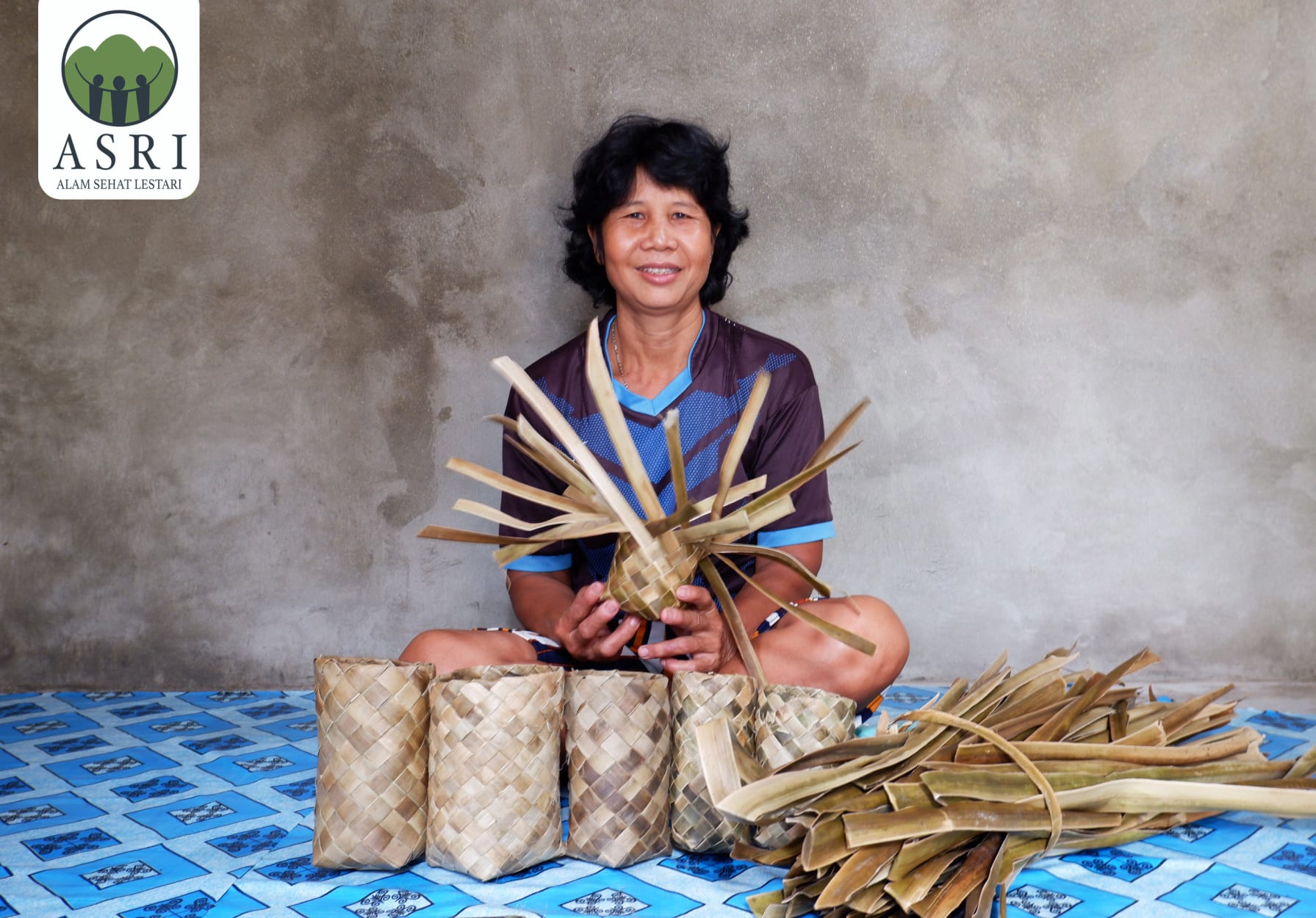
In the living room of his house, Ononlia (52) looks busy with his fingers. In front of him there were several woven tube-shaped containers that had been finished. On the left side there is a bunch of dried pandan leaves. On the same side there is also a long-handled knife which is more like a stick for splitting leaves.
“This is an awning. "I'm making lojok," he said while his right index finger pointed at a bunch of dry pandan leaves ready to be woven. Kajang is the name for thorn pandanus (Pandanus tectorius) by residents of Mawang Mentatai Village and surrounding villages in Menukung District, Melawi Regency. It is a tropical plant that usually lives on sandy beaches to highland forests.
Meanwhile lojok is woven from awnings in the shape of a tube measuring 7x18 cm. Used as a container for small household utensils. Apart from being made into a lojok, awnings can also be made into mats for sitting or for drying grain. Baskets are also made with ropes to carry. Usually used during the rice harvest season as a container for storing rice stalks. There is another type of weaving in the form of caping or local people call it tanggui.
In less than 10 minutes, Ononlia's skilled hands had produced 1 corner. Ononlia said that when she has free time and doesn't go to the fields, she can weave 40 knots a day. Making this lojok does not require special time. Ononlia said she had woven 400 knots in 2 weeks. "In those 2 weeks I was able to get 1 million," he said with a chuckle.
According to Ononlia, the amount of money he earned was quite large just to fill his free time. He also joked that making ecopolybags was an easy and relaxing job. "If people want to learn how to make this, it's easy," he offered, slowing down the weaving process so he could pay close attention.
Lojok, processed by the skilled hands of Ononlia and other women from 9 hamlets in 2 villages supporting the Bukit Baka-Bukit Raya National Park, is what the Alam Sehat Lestari-Bukit Baka Bukit Raya Team (ASRI-BBBR) buys and uses to become containers for tree seedlings. hardwoods and fruit trees. As a replacement for plastic polybags which are considered environmentally unfriendly and have the potential to pollute nature. So it can improve the quality of critical forest and land replanting activities without leaving behind plastic waste.
As explained further by the ASRI-BBBR Replication Program Assistant Manager, Barrata, this ecopolybag is a polybag made from natural materials. "So this ecopolybag is an environmentally friendly polybag. "This means polybags that can and are easily decomposed by nature," he said.
This thorny pandan is just one of many natural ingredients that can be used as an environmentally friendly planting container. There is also bamboo, nipah, and other natural materials.
Through a scheme for paying medical expenses at the ASRI Nusa Poring and Mawang Mentatai Clinics with seeds, people are directed to plant using these ecopolybags. Hardwood seeds and fruit seeds handed over by the community as reimbursement for medical expenses are temporarily stored in the nursery until they are ready to be planted in forests and critical land owned by the community.

"We are directing this ecopolybag to function as a polybag in general. "This means that if people want to plant hardwood or fruit tree seeds, then people are directed to use ecopolybags which are more environmentally friendly," he said.
There are at least 2 reasons behind ASRI-BBBR's choice to use ecopolybags from pandan duri. First, ASRI sees a negative risk to nature conservation if people continue to use plastic polybags. Because it has the potential to pollute the environment with plastic waste which takes a long time to decompose. Therefore, it is necessary to look for alternatives to plastic polybags that are more environmentally friendly. Lojok which is made from natural ingredients and is easily decomposed by nature is also an option.
"So ASRI saw that why don't we look at alternatives that are more environmentally friendly. "So ASRI sees this ecopolybag because it is made from natural materials and is easily decomposed, does not pose a risk of plastic waste in nature," he said.
Meanwhile, lojok, which is a cultural product of the local community in the form of woven work, is also mostly done by women. So ASRI sees the activity of making ecopolybags as a form of empowering women to improve the household economy while preserving culture.
Because the use of ecopolybags as seed containers is relatively new in the villages supporting the Bukit Baka-Bukit Raya National Park, it still requires getting used to it among the community. “We are slowly using ecopolybags. The hope is that in the future, people can switch to using ecopolybags. "So we can see that society is increasingly united with the use of ecopolybags," said Barrata.
However, the use of ecopolybags is nothing new for ASRI. Some time before in North Kayong Regency, ASRI had used ecopolybags for seed containers. In mid-2021, ASRI has signed a collaboration with communities from 3 conservation partnership groups supported by Gunung Palung National Park to make 35 thousand ecopolybags from bamboo for a period of 5 months. The previous year, ASRI also purchased 15 thousand ecopolybags from a group assisted by Laman Satong Village, North Matan Hilir District, Ketapang Regency.