From Cutting Trees to Raising Bees, A Former Logger Reflects on His Transition

Amir and a bottle of honey he harvested from wooden hive boxes in his backyard (ASRI Documentation)
Amir hadn’t been to school for nearly seven years when he touched his first chainsaw.
Born in Sukadana, like his parents and grandparents before him, Pak Amir grew up surrounded by the forests of West Kalimantan. As the fifth child in a family of eight, Amir had dropped out of the second grade to work on his family farm, planting cassava and rice to feed his family. While his parents farmed, his uncle was often in the forest, illegally cutting trees. One day, Amir asked to go with him.
Amir learned how to pick up his uncle’s chainsaw and balance it against his body. Even with his uncle’s help, however, the saw was still too long and heavy for him to use. At the time, illegal logging in West Kalimantan was rampant and life without it was unimaginable. There were only a few ways to earn money for basic necessities like healthcare. As a result, between 1985 and 2001, researchers estimate that more than 60% of protected forests in West Kalimantan were lost to illegal logging.
Like many other young loggers, Pak Amir started as an assistant to professional loggers, sweeping sawdust off of the threads they used to mark straight lines across logs. In a day, he could make 25,000 rupiah. While also working on his parents’ farm and helping neighbors clear their land, Amir started working with professional logging teams to transport cut wood from the logging site deep inside the forest to the river from where it could be transported more easily. A team of six would be hired to clear a path through the forest, lash freshly cut wooden planks into bundles of five, and then pull the wood along short wooden rollers, with Amir at the front, guiding the planks along the one kilometer path to the river. Paid by distance, he could make several times more than sweeping but, in 2013, he decided to become a logger.

Gunung Palung National Park Area in Kayong Utara, West Borneo (ASRI Documentation)
Fourteen years after he held his uncle’s chainsaw, Pak Amir used his savings to buy his own.
Despite working with loggers for over a decade, he still didn’t know how to properly use a chainsaw, so he spent six months learning how to smoothly cut wood from trees into useful pieces of different sizes. Since his primary customers were his neighbors, wanting wood for their homes and sheds, the first tree he cut was the nyatoh tree, an abundant hardwood commonly used in buildings. To get to these trees, however, he would hike three kilometers up a hill, into the forest behind ASRI’s clinic. It took just half an hour to fell a tree, but it could take him up to two weeks to chop it up because logging–despite providing most of his income–was still just one of the many jobs he would do. After cutting down a tree, he might leave to do some other work and come back a few weeks later to finish cutting it into planks. Despite these challenges and the risk of being caught, the work paid well. Amir could expect to make upwards of 3,000,000 rupiah per tree.
Read also: The Chainsaw Buyback Program: Creating Entrepreneurs
But since Pak Amir worked alone, his wife worried about his safety whenever he left. She had heard stories of trees crushing loggers in accidents and was concerned if something happened, no one would be there to help. She had known he was a logger when they got married and she hadn’t worried then but, as the borders of the nearby national park were expanded and marked, the chance of being caught increased.
Simultaneously, ASRI’s programs were expanding and the director of ASRI’s Chainsaw Buyback program came to Amir’s home one day in 2017 to explain the program to Amir. Chainsaw Buyback is one of three livelihood programs designed by ASRI to help reduce deforestation around Gunung Palung National Park. Loggers who are interested in quitting logging can reach out to ASRI and sell their chainsaws in exchange for grants and loans to start a new business and build a livelihood. For Pak Amir, the choice was easy. By the second meeting, he knew he was ready to give up logging.

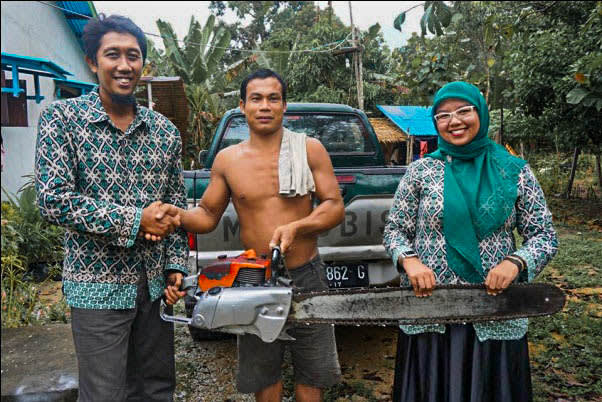
Amir giving up his chainsaw and officially became ASRI Chainsaw Buyback Partner (ASRI Documentation)
Parting with a chainsaw, however, is challenging. It’s not uncommon for loggers to have a strong bond with their chainsaw, explained one of the ASRI staff, “It’s like sending a son to college.” So when it came time to turn his chainsaw over, Amir turned it on one last time, to hear the growl of the engine and the buzz of the blades before giving it to the ASRI team.
For nearly twenty years, Amir had cut down trees, so getting used to his new life took a few months. Friends and family stepped up to support his transition by hiring Amir for odd jobs, like transporting sand from the river banks for construction projects, but this alone wouldn’t be enough. A friend suggested that he try the honey business so he bought ten hives and, after some success, asked ASRI’s support to increase his honey production: he received an interest-free loan from ASRI to purchase more hives. Today, he owns 100 hives across four locations and the honey he sells to neighbors, friends, visitors, and ASRI staff help him make up to 1.5 million rupiah per month. It’s significantly less than the tens of millions he could expect from logging and he knows he will need to start working other jobs to make more income, but he prefers it this way: closer to his family and much less stressful.
“It’s a good difference,” he says.
From the porch of his home, beneath a roof made from trees he once cut, Pak Amir thanked everyone who had persistently encouraged him to stop logging and join the Chainsaw Buyback program. Through this program, he has been able to both pay for his childrens’ education and preserve the forest for his grandchildren to enjoy one day.

Amir pointing out the roof made of woods he once cut in the national park area (ASRI Documentation)


