A Day With Our TB Heroes
One rainy morning in September, me and ASRI’s visitor tagged along with ASRI’s TB Coordinator, Hamisah and team to visit some Tuberculosis (TB) patients in Sungai Paduan village, bordering the Gunung Palung National Park. It took about 1 hour and 40 minutes, but with road conditions—that mostly are filled with big potholes—and the weather, it could take longer. Thanks to our experienced driver, we all managed to get there safely and on time.

The road condition to Sungai Paduan village (9/9).
Before we went to visit the patients, we met with one of the ASRI TB workers named Albekti. For 12 years, she has been one of our dedicated TB workers. Under the constant mild rain, Albekti, accompanied by her husband, rode on their motorbike, carefully leading us to our first TB patient.
A 51 year-old man with the initial D, was our first stop. He is currently in his 5th month of treatment, but before that he already received two-months of treatment. Due to the result of his examination of sputum or phlegm with direct microscopic acid-resistant bacteria (or Bakteri Tahan Asam in Indonesian/BTA), that said positive, as well as the rapid molecular test (or Test Cepat Molekuler in Indonesian/TCM, the gold standard for Indonesia). However, with his strong unwavering will to be cured from TB after a long battle with it, where D had to use the wheelchair because his mobilization was limited by his concerning underweight, now he managed to gain more weight, stand on his own feet and is able to do some field work such as farming, thought he is warned not to do hard labors that could worsen his health condition.
Also Read: ASRI's Commitment to TB Recovery: Overcoming Health Challenges in Sukadana
D lives with his wife and his daughter who were also suspected with TB. His daughter was diagnosed with TB and already finished her treatment, while his wife got some symptoms such as coughing, but after the examination the results said negative. ASRI’s visitor that came with us, Isabella, asked a very intriguing question: “If there was no TB worker to help you with your medication, would you still continue the treatment?”. With the help of Hamisah since D was speaking in the local dialect, he said that it would take up a lot of his time, especially for work. If there was no TB worker, he had to go to the nearby local health center and it does not always guarantee that his medication is available.
Our second patient is a 33-year-old young man with initial A. Upon our arrival, we were greeted by his mother, who I noticed got one of her legs amputated. Later on in our relaxed conversation with him, I found out that he also got diabetes, which he suspectedly inherited from his mother. Diabetes is one of the diseases that could complicate and affect a serious issue to the TB patients. Nowadays, the Ministry of Health has a protocol where diabetic patients are required to do TB screening and vice versa, since diabetes can lower the patient's immunity which makes them prone to get infected.
A told us in the local language, “Kalau gik ngumpul tuh, kawan-kawan saye selalu ingatkan saye untuk kurang-kurangi gula, minum manis-manis”, or in English he said that, whenever he hung out with his friends, they always reminded him to reduce his sugar intake and avoid drink sweetened-beverage. We all felt glad that he had supportive friends during his treatment, knowing that TB still has negative stigma in the community. A is in his third month or halfway through his treatment.
The third patient is a 49-year-old man with an initial S. When we arrived at his place, there were so many electronic devices and parts scattered around the living room, with his friends puffing in and out the smoke like a steam engine train. The air felt heavy and contaminated because the air circulation and ventilation were very limited, and the smoke was trapped in the rooms. Later, we figured out that S and his friends worked as repairmen for electronic devices and used his house as their headquarters.
His case became concerning when we found out that he was also a heavy smoker and that he had a 5-year-old kid living in that house with him. Our TB Coordinator, Hamisah, with her excellent approach to the community, advised him to stop smoking to prevent complications or failures in his TB treatment, knowing he is also halfway through his treatment, and certainly to protect his kid from the harmful effects of smoke.
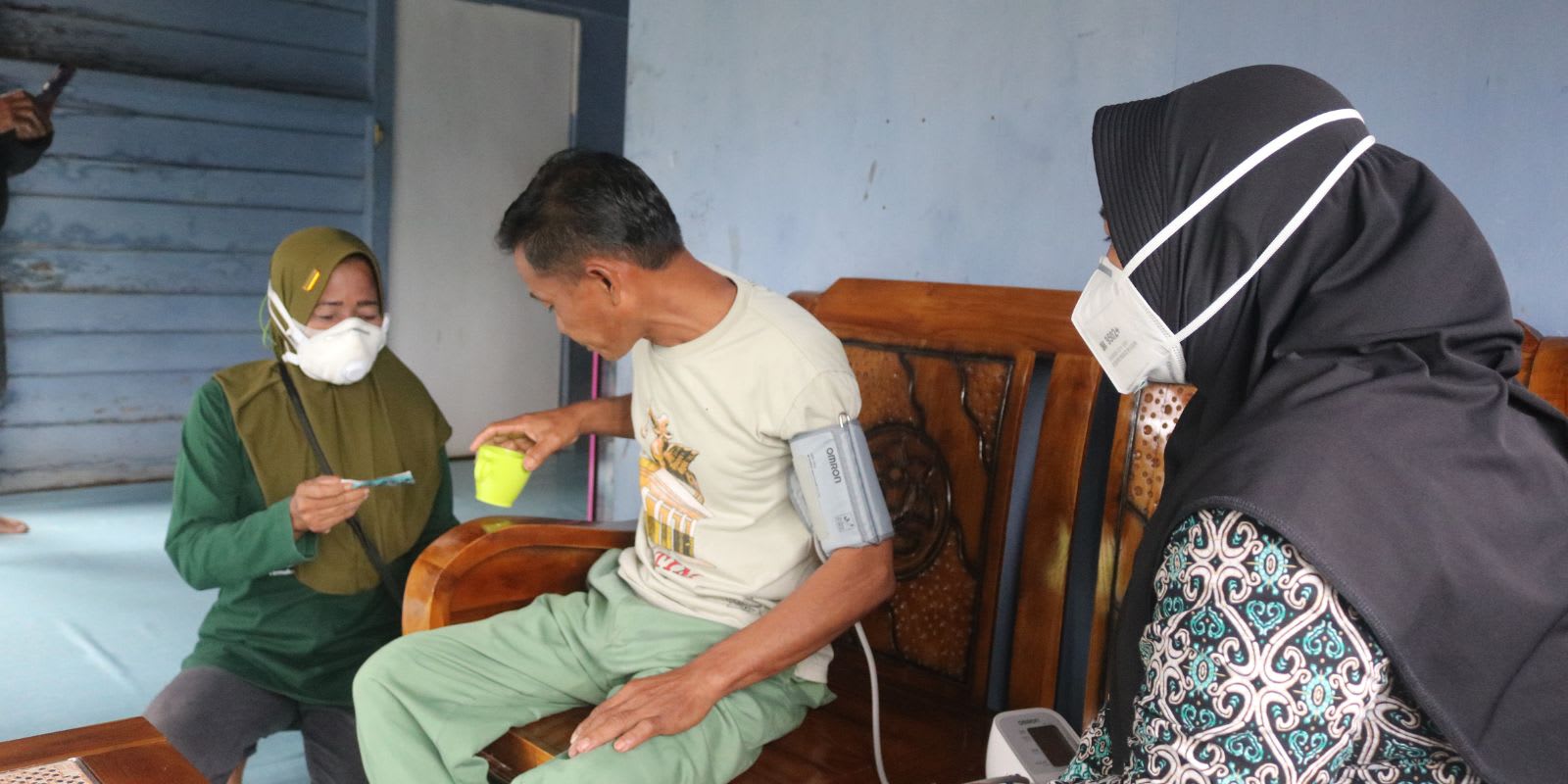
Our last stop was a 36 year-old mother with initial N, who has a 2 year-old daughter. Same with the previous patients, N was also in her third month of treatment. Her case is very crucial since she is still breastfeeding her daughter, making this little girl more prone from getting infected with TB. However, we all felt relieved when N showed us the medicine she got from the local health center (Puskesmas in Indonesian). Hamisah, explained to me and Isabella, that the medicine is part of the Tuberculosis Prevention Therapy, a required medicine for anyone who is living in the same household as TB patients, to reduce the high risk of being infected.

N was being checked for her blood pressure while holding her 2-year-old daughter.
From this trip, as someone who has no educational background in the medical field, I was completely moved by the efforts that were given by our team and the TB workers. Their dedication was shown on how they meticulously advised and consulted the patients, without making them feel ashamed, as TB still has negative stigma in the communities. Telling them steps that they should take, sharing experiences from other patients, and also nurturing hopes and optimism in these patients, to keep going, to finish their treatment and be cured from TB, so they can continue their daily activities. Also, closing the gaps and being closer with their loved ones without having any worry of TB, breathing down their shoulders.