Conservation or Community? Why Not Both!
Before the clock struck 8:30 in the morning, the ASRI clinic team was preparing tools, equipment and food stock for the mobile clinic session, which would take about a three-day trip to Pangkalan Jihing and Cali villages, from September 11th to 13th. The mobile clinic team for this session consists of two doctors: C. Anindita Putri, MD, one of our general practitioners, and Norma Yuniar, DMD, our dentist. They were accompanied by two clinic staff who would serve as a nurse and a cashier, and as well a driver. On this occasion, a clinic intern, a visitor, the Nursery Coordinator, and I decided to tag along with a rental car.
On our way, we stopped at this small shack in the middle of the oil palm plantations to have lunch and stretch out some sore muscles after about four to five hours of driving. When we arrived at one of the community’s houses, which the mobile clinic team uses as a place to stay, most of us wisely took advantage of this leisure time by taking naps or doing other things to recharge our energy before the mobile clinic started in the evening.

The road condition to Pangkalan Jihing village (9/11). Photo by Gianti Eriana.
At around 7:00 in the evening, we went to the nearby Pustu (a branch of the local health center). Some community members were already eagerly waiting for the mobile clinic session to begin. Darmawi, one of our nurses, with the assistance of Rhiska, our intern, and Isabella, our visitor part of the Planetary Health Exchange program who is currently studying medicine in Italy, swiftly collaborated to take care of each patient as they checked blood pressure, heart rate, and any other information the doctors needed.

Darmawi, assisted by Rhiska dan Isabella at the registration (9/11). Photo by Gianti Eriana.
After registration, I followed some of the patients to the doctors’ rooms—each of which was a humble space. Nothing fancy. First stop: C. Anindita Putri, MD, or simply called dr. Anin. A man in his 50s with an initial UA, accompanied by his wife, was explaining in the local language to dr. Anin about the disease he was suffering from. Standing in the doorway to respect the doctor-patient privacy, I heard his wife tell the doctor that her husband had an issue with his urination process, which caused him pain. With her fine composure, dr. Anin listened carefully and absorbed the information, though she admitted, after the mobile clinic hours, that sometimes she needed Darmawi or other locals to help her translate what patients were trying to say. She also mentioned that she had to deal with many people with varying personalities, which required her to quickly adapt. For instance, that night she discovered that one of her patients had not taken any of his prescribed medications, even though he insisted he had “taken” all of them.

C. Anindita Putri, MD, treating/consulting a patient (9/11). Photo by Gianti Eriana.
Next, I tagged along UA to the pharmacy and cashier—two roles that were expertly handled by Supatma, our Clinic Support Coordinator. With her fun and witty manner, she explained each medicine that was prescribed to the patients—from when to take it, how to take it, and each medicine’s function—as she wrote the instructions on the medicine packages. Sometimes she had to repeat herself, as most of the patients were elderly.

Supatma handled the pharmacy and cashier by herself (9/11). Photo by Gianti Eriana.
Moving to the dentist’s room with drg. Norma—and when I say “dentist's room”, please erase the typical setting you envision when you visit your dentist in the city or urban areas. There was no fancy chair with its array of tools and buttons. We had to make do with what we had: a plastic chair and the wall or window behind it for the patient’s head support. That means no big lamp overhead; we had a headlamp for lightning, manually held by our TB worker, Eva, for the village. Insane, right? I KNOW! Personally, going to the dentist alone can be a pretty anxious experience, so you can imagine the nerves of these patients—even the dentist herself—having to conduct procedures with such limited tools and facilities. drg. Norma performed a tooth extraction in under ten minutes, with no complaints from the patient, as she always ensured their comfort with such devoted care. I stood in the corner of the room, completely stunned, amazed and also terrified by how this could even work. The 32-year-old patient, with the initial T, told me, “Pertama kali tu takut cabut gigi, tapi ternyate ndak sakit kemarin (dengan dokter gigi ASRI sebelumnya). Cabut ni juga ndak kerase dengan dokter Norma.”

Norma Yuniar, DMD, performed a tooth extraction, with the assistance from Eva (9/11). Photo by Gianti Eriana.
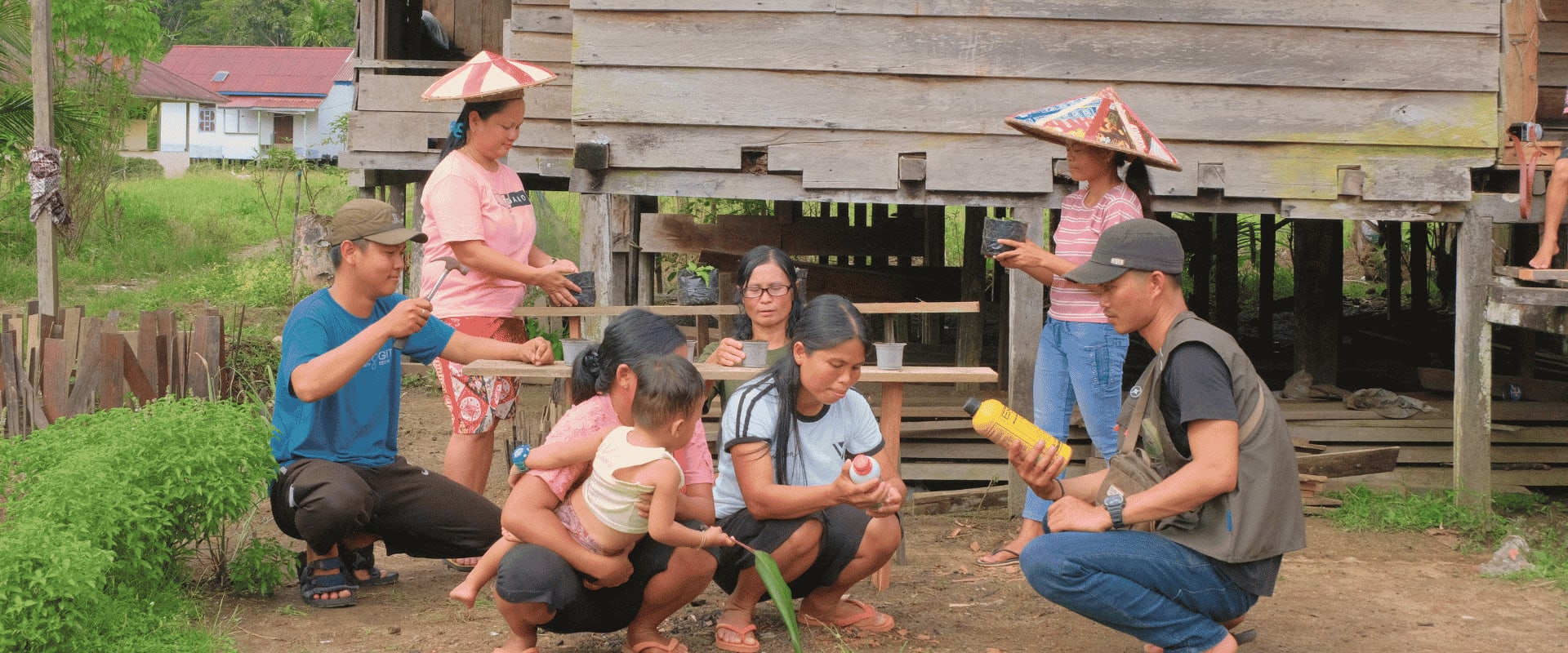
I kept going back and forth between dr. Anin’s room, dr. Norma’s room, the registration and the pharmacy to stay updated in case there were any interesting stories to collect—and I was right. UA, the man that we mentioned earlier, said that he was quite disappointed. As his spokesperson, his wife told us in the local language, “Niat mau setor bibit sekarang tapi ndak bise, besok la tu diambiknye”, or in English, she said that they were planning to turn in some seedlings to be put into their ‘clinic saving account’, but they could not do so at that moment. Adzi, our Nursery Coordinator, explained further that the car was going to be full with seedlings from Cali, our next mobile clinic location. Adzi told the couple that they would probably have to wait until next month (the next mobile clinic session for Pangkalan Jihing). I felt glad knowing the enthusiasm from the community for our mobile clinic, and how ASRI is able to bring high-quality healthcare closer to them, without making them worry about money.
After we finished packing for the evening session and returned to the house, I quickly fell asleep and slept soundly, without overthinking the horrors of climate change—the biggest challenge for my generation—as many of my peers and I often did. This was because I had just seen solid evidence that forests and people can live harmoniously together, meaning we do not have to choose one side over the other—community or conservation. Well, except for the horror of my nightmare about my tooth being extracted in such circumstances.
For the morning session in Pangkalan Jihing, the enthusiasm was still in the air. It was even more fun since there were many toddlers and children came to the Pustu to receive healthy porridge and pudding, as well as to have their growth progress checked (i.e., weight and height). It was a busy morning as Eva had to manage the toddlers and children, along with Roni, the Pustu’s nurse-in-charge , while Isabella, our visitor, assisted drg. Norma in the dentist’s room.
One interesting case from the dentist's room involved drg. Norma extracting an infected tooth with a cyst. She later explained that this typically occurs when the infection causes chronic inflammation. Ideally, this procedure would be performed in a clinic with proper equipment, but thanks to her high level of expertise, she was able to extract the tooth successfully, and the patient had no complaints.

Morning session for the mobile clinic in Pangkalan Jihing village (9/12). Photo by Gianti Eriana. Photo by Gianti Eriana.

Norma Yuniar, DMD, performed a tooth extraction with the assistance of Isabella (9/12). Photo by Gianti Eriana.
As for dr. Anin, she told me that most diagnosed cases in Jihing involve high blood pressure. From her keen observation, this could be caused by inconsistent medication adherence and the habit of smoking. The ASRI’s medical team has already consulted on the case and formulated prescriptions they believe could be effective in reducing the high blood pressure. There are also cases where teenagers develop rashes on their skin, likely due to their habit of consuming ultra-processed food (e.g., nuggets). She further explained that the community in mobile clinic areas need continuous and intensive health promotions as part of prevention efforts. Prevention is crucial for ensuring the health of the community, especially considering the significant resources required to access primary healthcare facilities. The health promotion initiatives should focus on encouraging a healthy lifestyle that the community can adopt.

This photo wrapped up our mobile clinic session in Pangkalan Jihing village (9/12). Photo by Gianti Eriana.
Right after we had our lunch, we moved to Cali, which is not far from Pangkalan Jihing. We did the same thing as we had done when we arrived in Pangakalan Jihing: killing time by doing things that could recharge our energy before the session started in the evening, in the middle of the glaring September heat, right on the equator line.
The community in Cali has different characteristics from Pangkalan Jihing. There was less enthusiasm from the community, which seemed to stem from various factors. Sari Agustine Lisano, MD, our Head of Clinic, later stated that the community in Cali lacks awareness of the importance of health. Patient visits are often fluctuating, with some days having 10 patients and other days having none. That night, we had to wait for an hour after the session’s opening time before two mothers with their children arrived to get porridge and pudding. When we were about to close, a regular patient also came in to have his tooth extracted by dr. Norma.

Norma Yuniar, DMD, performed a tooth extraction (9/12). Photo by Gianti Eriana.
In the morning, we faced the same situation as the previous day: no patients were coming to the Pustu. So, Isabella and I decided to tag along with Adzi, who was going to collect some seedlings from the community in Cali. We were collecting seedlings from patients and our Forest Guardian. I watched as the back of the truck slowly filled up with hundreds of seedlings, stacked efficiently to optimize the limited space. Adzi told us that he could collect up to 1,000 seedlings, depending on their average height and species. Two of the challenges in collecting the seedlings from remote areas are the distance and the road conditions. It can be really dangerous during the rainy season, as the roads become muddy and slippery. The driver has to be extra careful when carrying a full load, so we need to use 4x4 vehicles.

Adzi, our Nursery Coordinator, on his duty collecting hundreds of seedlings from the community that will be used in our reforestation program (9/13). Photo by Gianti Eriana.
When we returned to the Pustu, unfortunately, there were still no patients, so we decided to pack our bags and head back to Sukadana. It was a long journey home, and I personally felt exhausted just thinking about being in the shoes of the mobile clinic team. Working in a mobile clinic, where you are stationed in remote areas for three days with limited facilities, requires true professional dedication and a compassionate heart—and our clinic team always delivers that every month to the community in need, whether they are in the mobile clinic areas or the surrounding community of our health clinic in Sukadana .