Dampak Berganda Eco-polybag Untuk Kelestarian Hutan dan Kesejahteraan Masyarakat

Restoring forests that were previously degraded for various reasons through reforestation activities is an effort to sustain life. For ASRI, this is an endeavor to achieve health and well-being, not only for humans but also for wildlife and their habitats.
However, this activity is often accompanied by plastic waste in the form of polybags used as tree seedling containers being left at reforestation sites. Even if not left behind at the site, the polybag waste still becomes trash elsewhere, as most of them are not reusable.
In 2020, starting from the local knowledge of the women living in villages surrounding Gunung Palung National Park, ASRI collaborated with the Gunung Palung National Park Authority to introduce an innovation to reduce plastic waste in reforestation activities. This innovation utilizes natural materials, namely bamboo, combined with the weaving skills of the women around the forest. The result is an eco-friendly seedling container that the weavers named “bakul bibit,” commonly known as an eco-polybag.
Since 2020, a total of 149,398 eco-polybags have been produced by nine groups of artisans from villages surrounding Gunung Palung National Park. It is estimated that replacing some of the tree seedling containers with eco-polybags has saved more than 700 kg of plastic polybags.
Read Also: Pandan Duri Eco-polybags Boost Productivity of Women in Mawang Mentatai and Nusa Poring Villages
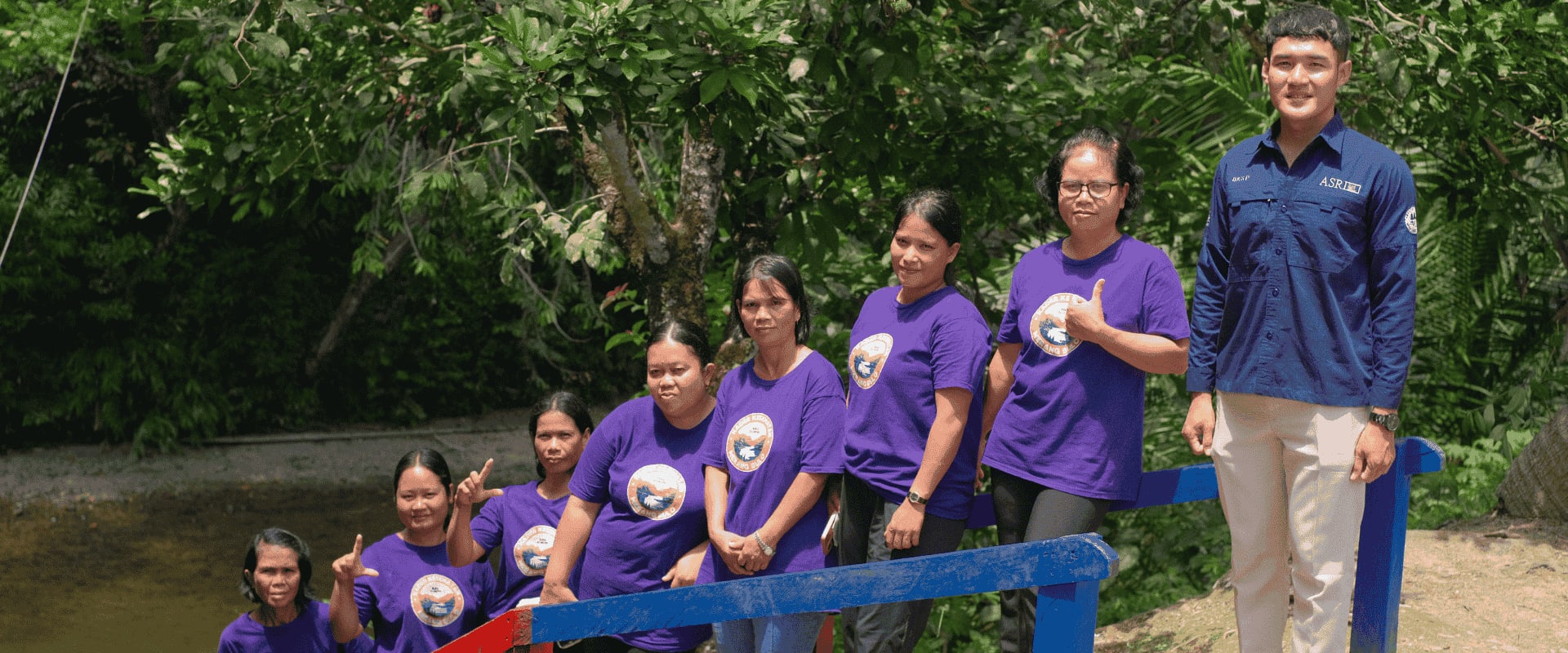
In addition to being eco-friendly seedling containers supporting efforts to restore degraded forests, the eco-polybags have also positively impacted the livelihoods of the weaving artisans. “We are happy to weave these seedling baskets during our spare time when there are no other activities. I believe all the women here are glad to earn extra income to support their families without having to leave their main work in the fields,” said Hasanah, the leader of the weaving group from Dusun Pasir Mayang, Pampang Harapan Village, Sukadana Subdistrict, North Kayong Regency, who named her group Sinar Baru.

For Hasanah and the weaving artisans, crafting eco-polybags is a way to make their free time more productive. A single group can receive orders for up to 2,000 eco-polybags, which are then divided based on each member’s production capacity and available time. Access to raw materials has never been an issue, thanks to the abundant bamboo supply around their village.
“We’re getting quite a few orders now. Our group can produce up to 2,000 pieces per month, depending on how much we can make. I personally can produce 200 to 400 pieces,” she said.
Read Also: ASRI's Commitment to TB Recovery: Overcoming Health Challenges in Sukadana
Eco-polybags are not the only type of woven product they make. However, what makes eco-polybags stand out from other woven crafts, aside from their role in the reforestation process, is their efficient use of raw materials. Eco-polybags have expanded the market for the artisans’ woven products.
Traditional bamboo crafts made by women in weaving groups around the forest, such as flat trays, conical hats, rice sieves, food covers, tissue boxes, and more, use the outer layer of bamboo. Eco-polybags, on the other hand, allow the inner part of the bamboo to be utilized for weaving as well.
In addition to empowering the local women economically in the villages surrounding Gunung Palung National Park, eco-polybags also simplify the planting process, thus reducing the time needed for reforestation activities. “With plastic polybags, you have to remove the polybag before planting the seedling. However, with eco-polybags, the seedling can be planted directly into the hole along with its container,” explained Hendriadi, ASRI’s Reforestation Coordinator.
ASRI hopes that eco-polybags can create a ripple effect in their efforts to realize prosperous communities around the forest and sustainable forests. This includes reforestation activities that aim to reduce plastic waste production, and providing weavers with additional income to improve their family’s economy.